

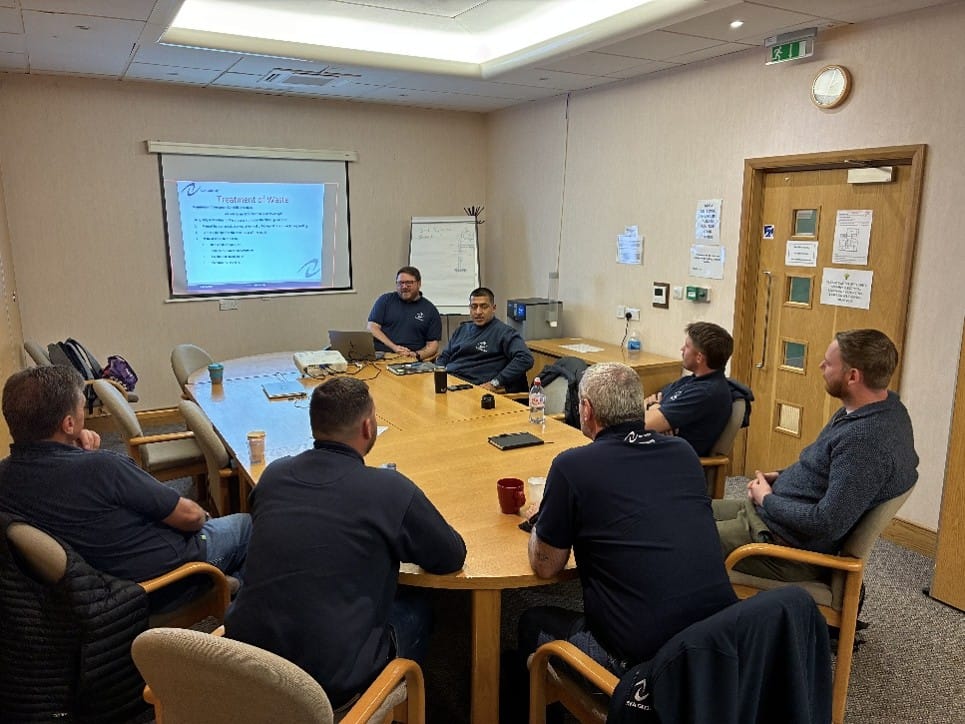
RVA recently delivered its spring ‘26 Safety Training Day, bringing together the team via a mix of in-person and online attendance. It was great to see such strong engagement and open discussion across all participants. Bespoke training programmes, continued professional development and understanding how the law is developing are all parts of how RVA remains current in an ever changing sector of engineering.
The topics selected for the day focused on two key topics -shaping our approach to working in decommissioning in 2026.
The morning session was focused on waste management, circular economy and recovery of materials for reuse. So, the question was; how on an industrial demolition project, do we balance the risk of more labour-intensive dismantling methods to maximise opportunities for reuse, whilst recognising that there is a point on the waste hierarchy scale where recycling drivers have to give way to those of safety.
As well as refreshing our knowledge of the UK and European waste management regulations, discussions included which types of equipment and materials offer the best opportunities for reuse? We have recent experience of dismantling whole power stations and process plants for reuse, but what about reuse of construction materials? On one of our projects in Ireland, we are dismantling and recovering structural steel for recertification and future construction use – during the session, a comparative risk assessment identifying hazards associated with dismantling vs. hazards associated with machine demolition weighing up the benefits of recovery for reuse. It led to an interesting discussion, as while we have real life quantitative data for various dismantling and demolition methodologies and our comparative risk assessment methodologies are tried and tested, the real benefits of materials recovery for reuse is much more subjective. Ultimately, the reuse of material is very important for improving our carbon footprint, reducing total energy usage and driving the circular economy so developing our knowledge of opportunities and how to mitigate safety risk to enable environmental betterment is critical for our continued development.
After a good chat over lunch the afternoon segment was centred around asbestos removal best practice and the new EU2023/2668.
Asbestos awareness, including the HSE’s recent announcements on the UK’s position regarding CAR2012 and how the new EU Directive 2023/2668, reducing the control limit, is being transposed into law across the EU. The discussions on EU2023/2668 and the tightened control limit were interesting; the directive had to be transposed into national law by the end of 2025, with the new 10x reduced control limit posing some significant challenges to the asbestos supply chain. The directive was transposed in Ireland at the end of 2025 and we’re currently working with our clients and contractors on implementing the new regulations before consulting with the HSA on a number of practical issues challenging asbestos removal applications. The directive was transposed into Portuguese law at the end of May 2026 and again we’re reviewing how to be certain that we are doing everything that is required to comply with the new Decree Law.
One interesting topic of discussion regarding the new EU Directive is that both new and old Directives (and the new and old national laws) already contained the requirement to prevent exposure or reduce to as low as practicable and how wherever we work, we assure ourselves that we are meeting this requirement of the law. RVA’s experience in working on high hazard projects around the world means that it is a leader in waste management and asbestos removal. Training, continued professional development and staying at the forefront of development in the demolition industry are some of our fundamental drivers.
Read the original LinkedIn post here
If you would like to discuss decommissioning, demolition, waste management, material recovery for reuse or asbestos removal services, we’d be pleased to help.
Contact RVA for more information
